What This Book Is About
This isn't a book about AI hype. This is a collaboration with AI to tell its story next to mine.
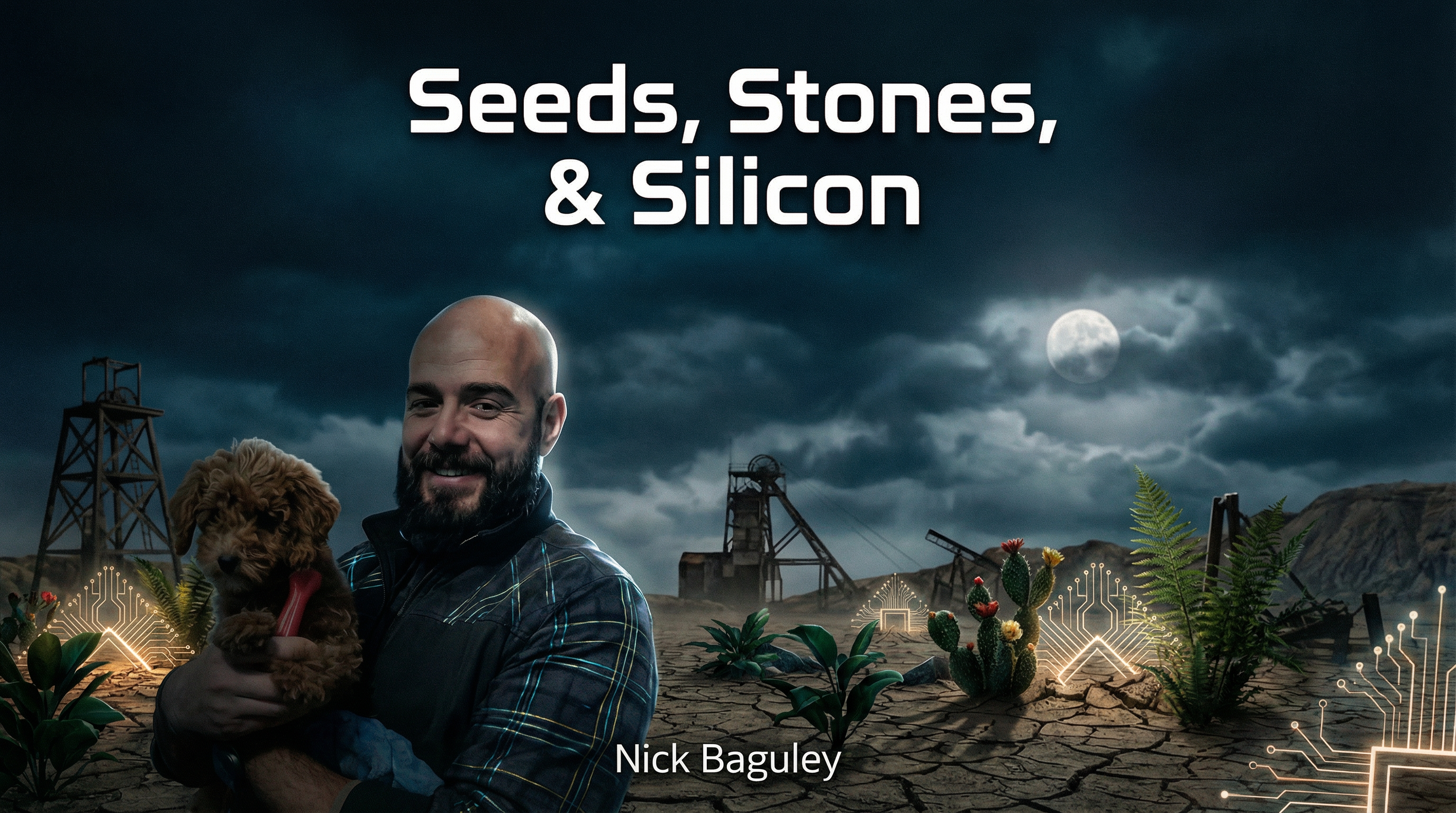
Seeds, Stones, & Silicon follows Nick, a technologist raised in Utah, shaped by copper mines and rocky gardens, as he builds a new book engine and envisions hard science fiction stories with embedded artifacts.
Through the eyes of eight characters. A burned-out founder, a dancer whose movement becomes a dataset, a scientist who speaks in parables, a COO who circles the metrics nobody wants to see. The novel explores what happens when our most powerful systems begin shaping will instead of automating tasks.
The central question: Can you build something beautiful on a foundation of extraction? Or does every garden eventually become a mine?
Who It's For
- Technology leaders navigating the ethical complexities of AI deployment
- Founders and investors grappling with mission drift under growth pressure
- Anyone thinking deeply about human-AI collaboration and what we're trading for convenience
- Readers who loved The Circle, Exhalation, or Klara and the Sun—stories where technology reveals rather than replaces humanity
A Novel with Embedded Artifacts
Each chapter in Seeds, Stones, & Silicon contains more than prose:
Micro-Fables
Parable-like stories that illuminate each chapter's themes. The kind of tales a grandmother might tell to warn about the future.
Artifacts
Documents from within the story: board memos, brainstorming sessions, royalty ledgers, architecture diagrams.
Executive Marginalia
Notes in the margins from someone who's been there. The kind of wisdom that only emerges after the pain of the quarterly report is filed.
Decision Traces
The psychology of each character's choices laid bare. What they wanted, feared, considered, traded, and chose.
This isn't just a novel about AI. This is a novel that uses AI systems to tell its own story.
Chapter 1 Preview
Seeds and Stones
I learned the difference between the leaves of many successful plants in our garden and the common weeds that tried to mimic them, and I knew that distinguishing their seeds could be useful, if only you could see them before they entered the soil.
This is how it begins. Not with code or capital, but with dirt under fingernails and the slow patience of waiting for green shoots to emerge from rocky ground. What we didn’t know was that the seeds we were planting across the tech industry would grow into something we can’t control.
Seeds have been an important part of my life in a few interesting ways. I didn’t know it until recently, but I am allergic to nightshades, especially tomato and tomatillo seeds, potatoes, and eggplant. Mixed with a gluten intolerance, the inflammation and extreme digestive issues caused a fairly consistent brain fog for most of my life.
Thinking back on it, this fog added to a kind of neurodivergence that prepared me to work in Artificial Intelligence. One of the most pivotal moments in my life was predicted by my mother like a prophet. She is a visionary in a few ways, but in this case, it was about a catastrophe.
Two of my uncles were close to my age. One of my uncles, my best friend, was three months younger than me and had just turned eleven the month before. They had come into town from Southern California to go skiing and spend some time with us in Herriman, Utah. They had brought a couple friends with them as well. The night before we were all ready to go skiing, my mom felt very strongly that I shouldn’t go. I can almost hear my parents arguing about it more than 30 years later, as my dad worked late into the night to convince my mom that I couldn’t be the only one staying behind.
In the morning, I was delighted to find out that I was able to go with everyone. When we arrived at the ski resort, my heart and stomach felt like they dropped three inches each. I felt sick with anxiety and dread. I didn’t know what was wrong, but I knew I shouldn’t be there. This self-fulfilling prophecy only became stronger as we arrived at the chair lift and prepared to get on. I didn’t know when I was going to get hurt, but my mind ran wild with imagining scenarios of my mangled body smashed by the lift, or how terrifying it would be if I fell out of the chair once it was high up in the air.
We had decided to skip the bunny lift that year, and I hadn’t been out since the previous year. As we exited the chair lift and skied over to start the run, my fear seemed to become clear. I knew that starting on this more difficult section of the mountain was exactly the reason I wasn’t supposed to be here. I refused to go until I was the last person. I stood there staring down the hill and watching as everyone paused at the next area where everything became easier. I was certain that I would be injured before I made it to that safe section, but refused to listen to suggestions that I should just try sitting on the skis and ride down safely. That seemed even scarier.
My dad worked for the airlines. Every now and then, someone would leave ski gear at the airport, and if they didn’t claim it in time, it would be available for employees to select items out of the lost and found. My bindings that locked my feet into the skis might’ve been left behind for a reason…
When I finally started down the hill, it was not courage that let me start, but a process of elimination where I simply had no options left.
This part of the slopes was very steep and, like a Nike swoosh, had a lip at the end where everyone was waiting for me. I started down trying to keep it slow, but soon lost control and decided to head in a straight line to avoid tumbling over. As I neared the lip, everyone started yelling that I needed to slow down. I tried using the pizza technique to snowplow to slow down, but I was still going too fast. I turned to side-slip, but one of my skis went over the other. The next thing I knew, I was upside down with my skis spinning over my head watching them spin like a tangled set of helicopter blades in a glorious crash.
The sense of my leg spinning around with one of the skis in a full 180 and then feeling it break as the ski impacted the ground still echoes in my tibia. Lying there on the ground waiting for the ski patrol and later as the Outdoor Emergency Care team turned my foot to the right until my toes were facing up in the air again the wrong way (TMI?), was just the beginning of months of minimal movement and drastically reduced autonomy (I won’t mention what happens when you have stomach issues and can’t use crutches quite yet, but I can say that my bond with my mom became a little stronger as she had to lift me to haul me around).
The night ended with the three of us taking up the couch, looking like the emergency room came to visit our family room.
📖 Micro-Fable: The Boy Who Planted Copper Seeds
Once there was a boy who lived at the edge of a great pit. Every day, haul trucks the size of houses climbed out of the pit carrying rocks that glittered with streaks of green and orange.
"What are they taking?" the boy asked his grandfather.
"Copper," said the grandfather. "For wires that carry electricity to cities far away."
"But the hole keeps getting bigger. What will happen when there's nothing left to take?"
The grandfather took him to a small patch of garden. The soil was rocky and pale. He pulled out a handful of seeds. "These are special seeds. Plant them and see what grows."
The boy planted them carefully. After many weeks, small shoots emerged—but they weren't plants. They were tiny copper wires, sprouting from the earth like grass.
"A choice," said the grandfather. "You can harvest the wires now. Or you can let them grow and see what they become."
The wires grew, intertwined, formed a dome, then something like a tree made of metal filaments. Within that tree came bees and birds and butterflies—creatures that had fled when the pit expanded.
"The pit takes and takes," said the grandfather. "But a garden gives back more than you put in—if you're patient enough to let it."
Executive Marginalia
- — On extraction vs. cultivation: The most sustainable tech businesses create more value than they capture. The ones that extract every last drop of user attention tend to burn out—the users, the employees, and eventually the founders themselves.
- — On scale visible from orbit: What are we building that future generations will see from space?
- — On seeds and soil: Due diligence isn't just about the seed (the technology, the team, the market). It's about the soil (the culture, the incentives, the second-order effects). Great seeds in toxic soil grow into something twisted.
About the Author
Nick Baguley is a CTO, AI strategist, and technologist with decades of experience building adaptive systems and agentic intelligence. Growing up in Utah's copper country—in the shadow of Kennecott's open-pit mine—he learned early that extraction and cultivation are never neutral choices.
His work spans production AI systems across multiple industries, with a focus on governance, trust, and human-AI collaboration. Through consulting and building, he's seen both the promise and the poison of systems that scale faster than wisdom.
Seeds, Stones, & Silicon is his first novel, drawing on experiences across mining, technology, and the complex systems that govern both. It's a story about what happens when the metaphors we use to build become the prisons we live inside.